




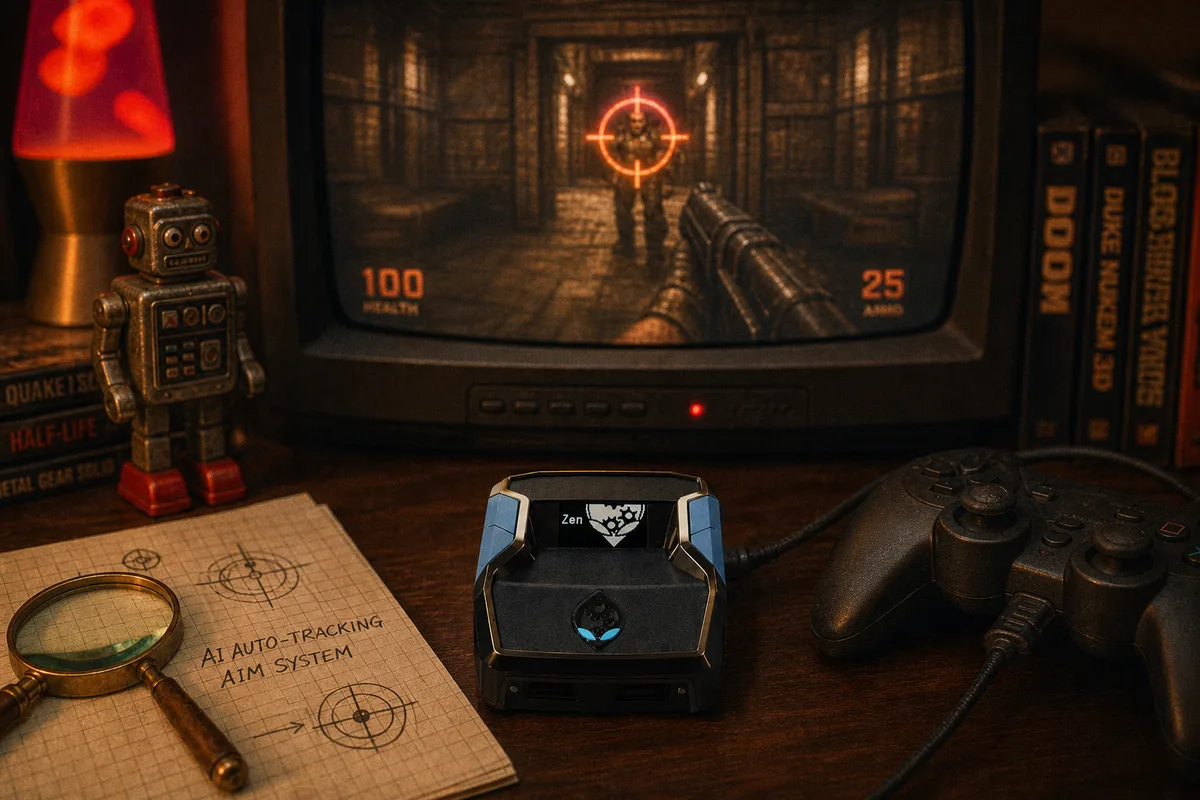
AI Auto-Tracking is the mod people buy Champion for, and it's also the mod with the most nonsense written about it — half the internet thinks it's an aimbot, the other half thinks it does nothing. Both are wrong in instructive ways. I built the thing, so let me walk you through what actually happens between your thumb and the game, layer by layer.
Ground Rules: What the Hardware Can See
The Cronus Zen sits between your controller and the console. Everything it knows arrives through the controller: stick positions, button states, trigger values, polled continuously. It has no video feed, no game memory access, no network taps. This constraint isn't a limitation we work around — it defines the entire design space. Whatever Auto-Tracking does, it does by transforming the input stream and nothing else. The console, meanwhile, sees a standard controller and receives ordinary controller packets. If you want the full plumbing story, how Cronus Zen scripts work covers the architecture.

The Three Flaws in Human Stick Input
Point a motion-capture rig at a controller player's thumb during a tracking fight and you'll find the same three error patterns, every player, every skill level:
- Jitter — high-frequency noise around the intended aim path. Thumbs are muscles; muscles tremor. On a stick, tremor becomes reticle shake.
- Overcorrection — when a target changes direction, players swing past the new position and have to swing back. The correction is usually bigger than the error that prompted it.
- Hesitation — brief moments of near-zero stick input while the brain catches up: after getting shot, mid-reload, during a target's jump. These pauses are invisible to the player and deadly to tracking.
Hesitation is the sneaky one, because of how Fortnite's aim assist works. As I covered in the aim assist explainer, rotational assist only contributes while your sticks are actively moving. Every hesitation gap doesn't just pause your aim — it disengages the assist system too. Double penalty.
What the Tracking Layer Computes
Auto-Tracking runs every polling cycle while you're aiming. Conceptually, each cycle does three things:
1. Read intent
The script reads your current stick vector and maintains a short history. From that history it derives what you're trying to do: the direction and rate of your intended track. A steady rightward pull with small vertical variance reads as "tracking a strafing target"; a fast large swing reads as "flicking to a new target." The classification matters because the correct refinement differs.
2. Filter the flaws
Against the intent estimate, the three error patterns become separable. Jitter is deviation that reverses too fast to be deliberate — it gets smoothed. Overcorrection is a swing that exceeds the plausible target motion implied by your recent inputs — it gets damped before the pendulum runs away. Hesitation is a near-zero input sandwiched between active tracking — the script bridges it, sustaining the track your own history says you intended.
3. Output refined input
The refined vector goes to the console inside an ordinary controller packet. Note what did not happen: the script never chose a target, never knew where the enemy was, never added aim you didn't initiate. If you aim at the sky, Auto-Tracking will faithfully refine your aim at the sky.
 Watch the tracking in a real match — demo footage
Why It Feels Stronger Than It Sounds
Input smoothing sounds mild. The felt effect is not, and the reason is the aim assist interaction. Continuous, well-shaped input keeps rotational assist engaged through the whole fight instead of in fragments between your hesitations. So you get a compounding effect: your input is cleaner, and the game's own assistance operates on that cleaner input more of the time. Players describe it as aim assist feeling "stickier" — the values never changed, the uptime did.
It also stacks with the rest of Champion's aim suite. Anti-recoil removes the downward counter-pull from your input budget; anti-bloom paces shots so spray spread stays honest; AI Beam extends the same refinement philosophy to long-range beaming. Each mod removes one source of noise, and tracking is what remains when the noise is gone.
The Honest Limits
- It cannot acquire targets. If your crosshair placement is bad, refined input is refined-but-misplaced input. Crosshair placement remains the highest-value raw skill in the game.
- It cannot fix decisions. Wrong fight, wrong range, wrong timing — the script tracks beautifully all the way through a fight you should never have taken.
- It is not undetectable magic. The console sees a standard controller and we don't promise anything beyond that — anyone who promises "unbannable" is lying to you, and I'd rather you hear that from us.
Try It Properly
Champion is $50 one-time — free weekly updates included whenever Fortnite patches, no subscription — and runs on PS5, Xbox, and PC. If you're evaluating it, watch the demo first, then give it one full session in creative before judging: the input pipeline feels different for the first twenty minutes, and then it feels like your thumb on its best day, every day.
Champion — AI Auto-Tracking and the full Fortnite suite, $50 one-time
Champion full review — every mod covered
The controller settings that pair with Auto-Tracking