


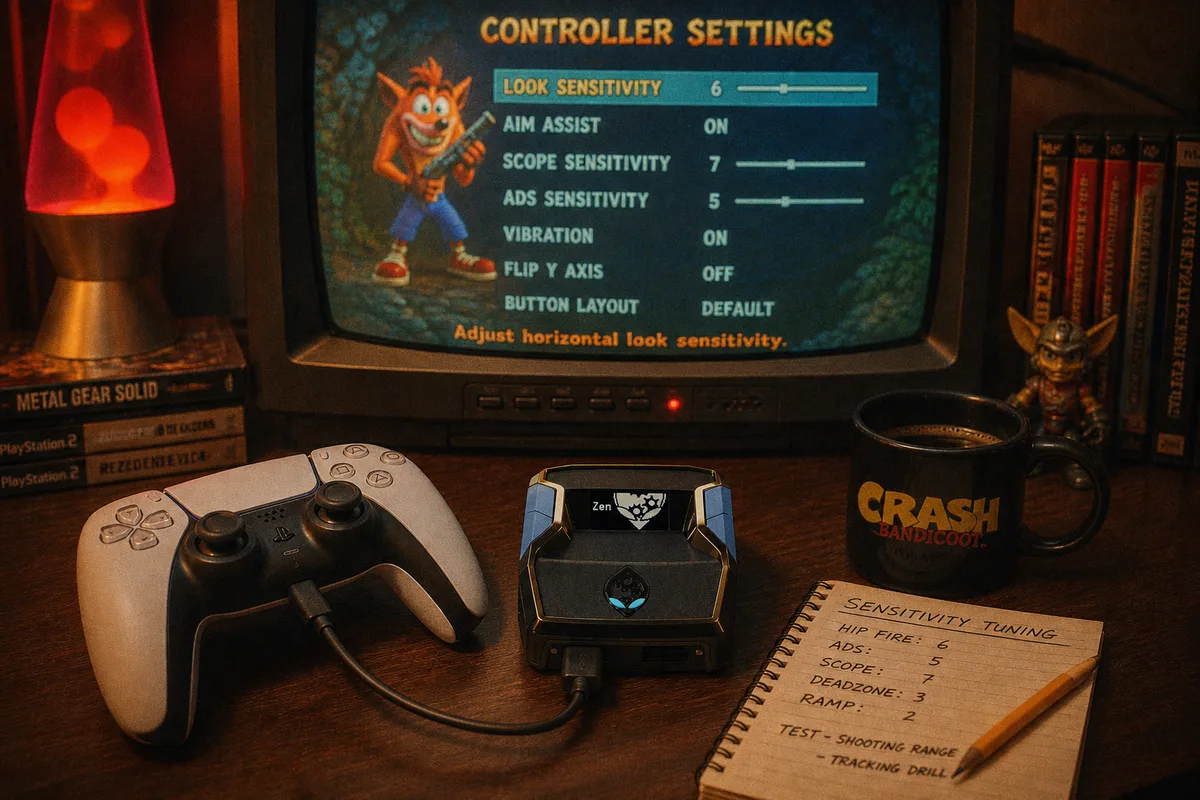
I handle most of the script tuning at yew.gg, and the support question I see most after "how do I set it up" is "what settings should I run with it?" Fair question — a Cronus Zen script processes your stick input, so in-game settings that shape that input either cooperate with the script or fight it. These are the Fortnite settings I recommend under Champion in 2026, with the reasoning for each so you can adjust intelligently instead of copying blind.
The Principle: Don't Double-Process
Champion's AI Auto-Tracking layers micro-adjustments onto your stick input. Fortnite then applies its own processing — deadzone, response curve, sensitivity multipliers — to what it receives. If your in-game settings aggressively reshape input (big deadzones that eat small movements, exponential curves that amplify the ends of the range), you're distorting the refined signal the script produced. The goal of everything below is a clean, predictable pipeline: your thumb, the script's refinement, then minimal in-game reshaping.

Sensitivity
| Setting | Recommended | Why |
|---|---|---|
| Look Horizontal Speed | 42-48% | Enough for 180s without shrinking aim assist's working room |
| Look Vertical Speed | 38-44% | Slightly under horizontal — vertical overshoot is the most common tracking error |
| ADS Look Horizontal | 14-18% | Tracking happens here; lower is more stable under Auto-Tracking |
| ADS Look Vertical | 12-16% | Anti-recoil handles the climb, so you do not need fast vertical ADS |
| Edit Mode Sensitivity | 1.4-1.6x | Tile selection should keep pace with Turbo Edit's faster confirms |
The ranges are deliberate. Your grip, controller, and monitor distance all shift the right value inside the range — but starting outside these ranges is where I see people create problems. The most common mistake is ADS sensitivity set way too high because it felt good in a sensitivity trainer; under Auto-Tracking, high ADS sens means both you and the script are making larger corrections than necessary, and the result feels twitchy.
Deadzones and Response Curve
Set look deadzone as low as your sticks allow without drift — usually somewhere between 5% and 10% on a healthy controller. The script's micro-adjustments are small by design; a fat deadzone swallows them. If you need more than 12% deadzone to stop drift, the honest fix is replacing your sticks, not raising the number.
Use the linear response curve, not exponential. Linear means stick deflection maps directly to turn speed, which keeps the script's adjustments proportional and predictable. Exponential feels forgiving for raw thumbs but it makes the same physical stick movement produce different in-game results depending on deflection — exactly the inconsistency the script exists to remove.
Leave aim assist strength at maximum. There is no configuration under a Zen where reducing it helps you.
 How Fortnite aim assist and the Zen actually interact
Binds That Cooperate With the Script
Champion's macro suite and Turbo Edit fire from your binds, so bind placement is part of your settings:
- Edit on a paddle (or L3 if you have no paddles). You should never lift your right thumb off the stick to edit — that is the moment your tracking and the script's refinement both go dark.
- Builder Pro for build binds — it remains the fastest stock layout, and the macro configs that ship with Champion assume it.
- Confirm edit on release is a personal call: it pairs well with Turbo Edit for pure speed, but it removes your ability to pre-select tiles and hold. I run it off; yew runs it on. Try both for a full session each.
- Sprint on toggle, not hold — one fewer thing your left hand is holding while the right side of the controller does the work.
Testing Changes Properly
Change one variable at a time and give it a full session, not one match. Sensitivity judgments made in the first ten minutes are noise — your hands recalibrate to almost anything within an hour, so what you are actually testing is where your accuracy settles after adaptation, not how it feels on contact. Keep a note of your current values before changing anything so you can revert cleanly.
A good structure: creative aim map for ten minutes, three real matches, then check whether your mid-range tracking felt more stable or less. Mid-range tracking is the most script-sensitive skill, so it is the best canary for a settings change that fights the pipeline.
If You Have Not Set Up Yet
All of this assumes Champion is loaded and running — if you are starting from an unopened Zen, the 2026 setup guide takes you from box to first match in about fifteen minutes, and the Zen Studio guide covers loading the script. Champion is $50 one-time with free weekly updates, and these settings recommendations get revisited whenever a Fortnite patch changes input handling.
Champion — Fortnite Cronus Zen script, $50 one-time
Watch Champion running with these settings
Fortnite Ranked with Cronus Zen — full season guide